Earth & Environmental Science
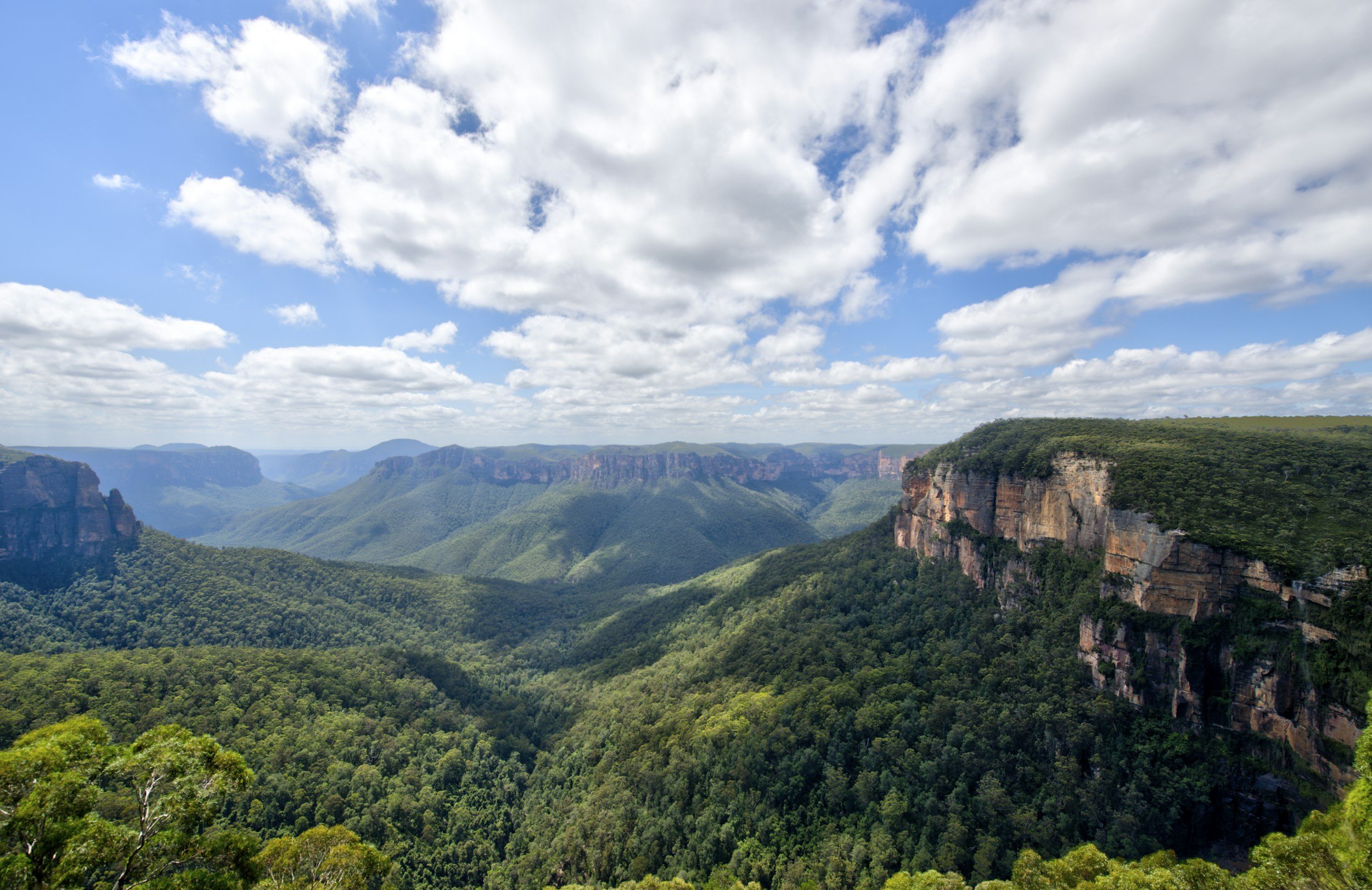
Blue Mountains
Explore ancient geology, temperate rainforest, and fragile ecosystems firsthand - from ranger-guided cliff top walks to hands-on environmental change field studies in a World Heritage landscape.
3 Day Sample Itinerary
-
Day 1
Depart for the Blue Mountains
Echo Point & The Three Sisters Lookout
Teacher-guidedGrand Cliff Top Walk
3-hour ranger-guided hike through the national parkCheck in at Accommodation
Blackheath Spotlight Walk
Nocturnal wildlife tour at Govetts Leap -
Day 2
Scenic World
Guided tour through the Jamison Rainforest via Railway, Cableway & Skyway
Blue Mountains Botanic Garden Mount Tomah
Environmental Change & Management Program (vegetation surveys, mapping & field testing)
Evening campfire and bush cooking -
Day 3
Depart Blue Mountains for Home
“Our Year 12 Earth and Environmental Science students had an outstanding experience with Unearth-Ed on our 2-night, 3-day Blue Mountains excursion.
Our guide on the Wentworth Falls hike was a park ranger who was incredibly knowledgeable and tuned in to exactly what our students needed.
Every experience across the three days came with dedicated, educated guides, and everything linked back to the HSC syllabus, giving our students relevant experiences while still being genuinely fun.
The organisation was seamless from booking through to the trip itself, which made life so much easier for us as teachers. We'd recommend Unearth-Ed to any school without hesitation, and we'll definitely be back.”
- Wingham High School
Travelled with Unearth-Ed on this tour in 2026
How Canberra can align with
the National Curriculum
-
“Students develop the knowledge, skills, and values to participate as active and informed citizens.”
Canberra provides students with direct exposure to Australia’s democratic system and national institutions. Through guided experiences, students explore how laws are made, the roles of elected representatives, and the responsibilities of citizens within a democracy. These visits bring abstract civic concepts to life, supporting classroom learning around governance, participation, and national identity.
Key Attractions:
Parliament House
Museum of Australian Democracy (Old Parliament House)
High Court of Australia
Australian Electoral Commission Education Centre
-
“Students develop knowledge, understanding and skills to make informed decisions about health, wellbeing and physical activity.”
Outdoor learning environments in Canberra encourage active participation and engagement with the natural world. Students can explore personal and community wellbeing, resilience, and respectful relationships through both structured programs and reflective learning experiences. Physical activity components of tours also support the development of movement skills and personal responsibility.
Key Attractions:
Australian Institute of Sport
Mount Ainslie
Lake Burley Griffin
National Arboretum Canberra, e.g. orienteering
Cycle Canberra
-
“Students investigate the past to understand the present.”
Students engage with primary sources, national memorials, and curated exhibitions that examine Australia’s social, political, and military history. Visits encourage inquiry into continuity and change, perspectives, commemoration, and the significance of historical events. Canberra’s national institutions provide meaningful opportunities for students to analyse evidence and reflect on Australia’s evolving story.
Key Attractions:
Australian War Memorial
National Museum of Australia
National Archives of Australia
Old Parliament House
-
“Students explore the relationship between people and their environments.”
Canberra’s planned design and surrounding landscapes offer opportunities to examine urban planning, sustainability, and environmental management. Students investigate how natural and built environments interact, how places are designed for purpose, and how communities respond to environmental challenges. Fieldwork elements can support geographical inquiry skills and spatial awareness.
Key Attractions:
National Arboretum Canberra
Lake Burley Griffin
Australian National Botanic Gardens
Mount Ainslie Lookout
-
“Students engage in creating and responding to artworks.”
National cultural institutions provide exposure to diverse artistic practices, historical works, and contemporary expressions. Students analyse visual storytelling, symbolism, and creative techniques while responding to artworks that reflect Australia’s cultural identity. Many venues offer guided workshops that support artistic exploration and critical reflection.
Key Attractions:
National Gallery of Australia
National Portrait Gallery
National Film and Sound Archive
Canberra Glassworks
-
“Students design and produce solutions to identified problems.”
Through interactive exhibitions and innovation-focused programs, students explore scientific principles, engineering processes, and technological advancements. Experiences encourage design thinking, experimentation, and problem-solving, reinforcing classroom learning in STEM disciplines.
Key Attractions:
Questacon – The National Science and Technology Centre
CSIRO Discovery Centre
Australian Mint
-
“Students develop scientific knowledge, understanding and skills to investigate the natural and physical world.”
Canberra offers interactive and inquiry-based environments where students can explore scientific concepts through experimentation and observation. Experiences support the development of scientific inquiry skills, including questioning, predicting, analysing evidence, and communicating findings. Visits reinforce classroom learning in physical sciences, biological sciences, Earth and space sciences, and STEM applications.
Key Attractions:
Questacon – The National Science and Technology Centre
CSIRO Deep Space
Australian National Botanic Gardens
National Arboretum Canberra
Geoscience Centre
Mt Stromlo Observatory
-
“Students learn to listen to, read, view, speak, write and create increasingly complex and sophisticated texts.”
National institutions provide rich opportunities for students to analyze primary sources, persuasive texts, historical narratives, and visual storytelling. Through exhibitions, guided discussions, and reflective tasks, students interpret multiple perspectives and develop critical literacy skills. Experiences support comprehension, analysis, and the creation of informed responses to real-world texts.
Key Attractions:
Museum of Australian Democracy
National Archives of Australia
Australian War Memorial
National Museum of Australiaescription
-
“Students develop mathematical understanding, fluency, problem-solving and reasoning.”
While not always an obvious link, Canberra’s institutions provide authentic contexts for applying mathematical reasoning. Students can explore measurement, scale, data interpretation, financial literacy, and spatial awareness through real-world examples. Integrating mathematics into excursions supports applied learning and strengthens connections between abstract concepts and practical use.
Key Attractions:
Australian Bureau of Statistics (education resources)
Australian Mint
National Arboretum Canberra (mapping, scale and design concepts)
Parliament House (design, symmetry and spatial planning)
Why Partner With Us
-
Experienced 1:1 Tour Co-ordinator
Our friendly and dedicated team of tour co-ordinators will provide you with one on one service throughout the entire process of booking and travelling on your school excursion.
-
Customised Tour Packages
We create customised tour packages that encompass all travel, accommodation, entry to attractions, gear hire, coach transfers and information on specific seasonal or local details that could affect the smooth running of educational travel.
-
For Your School’s Safety and Comfort
We meticulously plan each trip, ensuring destinations meet strict safety standards, and provide reliable transportation options with experienced tour guides trained in first aid and emergency procedures.
We are here to help you plan your school excursion.
Please download our Canberra tour brochure for further tour information.